Parliament
Harsha de Silva Says the IMF's Central Bank Rules Leave No Room for the Government's Industrial PolicyDe Silva: IMF Rules Box In Industrial Policy
The opposition MP who chairs Parliament's Committee on Public Finance told the House on 16 November that the government's acceptance of an independent central bank under the IMF programme sits uneasily with its own Marxist-Leninist roots and its plans to steer the economy.

One of the opposition's leading economists has accused the government of a contradiction at the heart of its economic programme: promising to steer the economy towards new industries while accepting rules under its International Monetary Fund agreement that take the most powerful steering tool, the central bank, out of its hands.
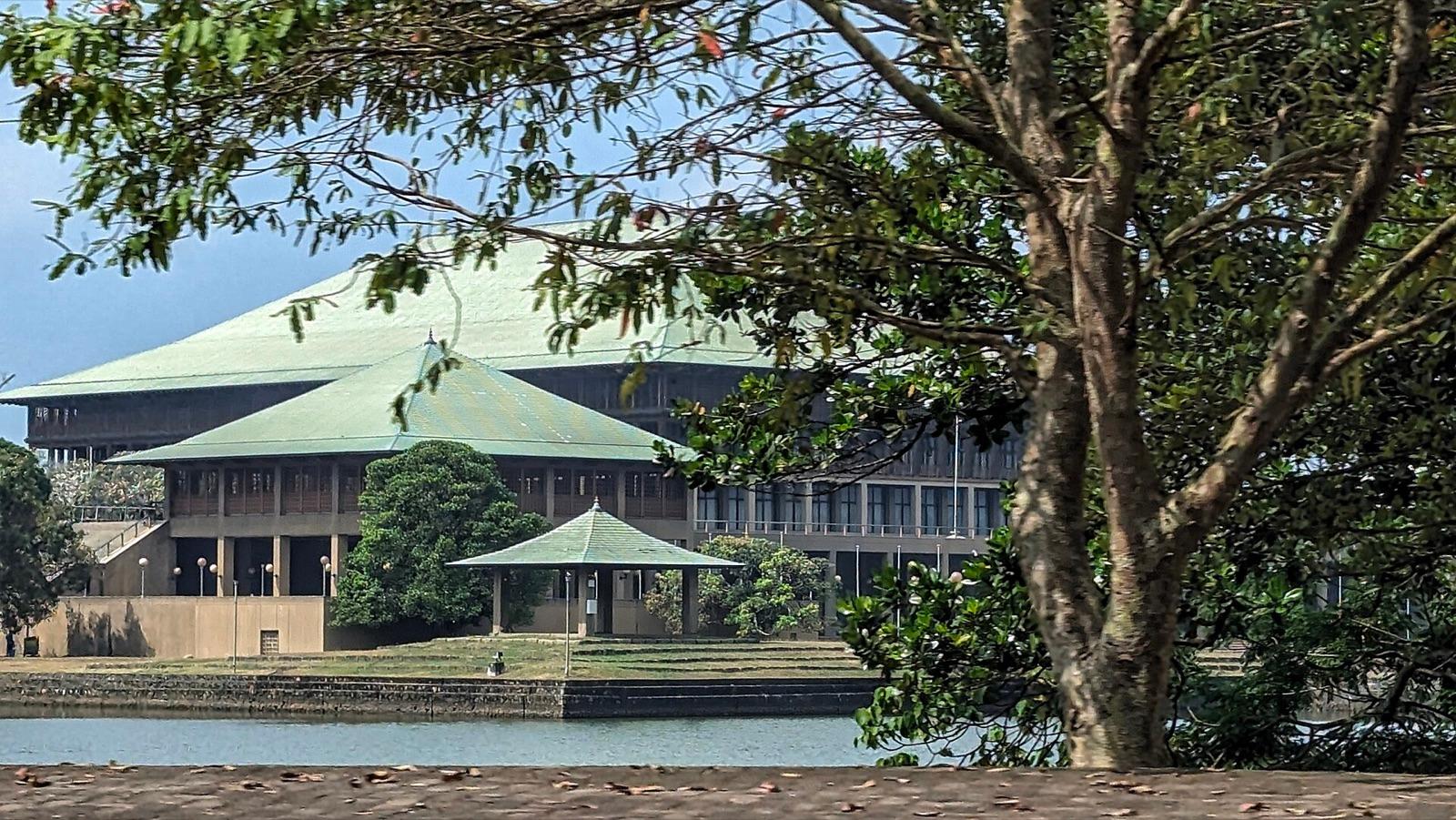
Speaking in Parliament on Monday, 16 November, Dr Harsha de Silva, a Samagi Jana Balawegaya (SJB) MP and chairman of the parliamentary Committee on Public Finance, said the National People's Power (NPP) government's deference to the IMF's insistence on an independent Central Bank of Sri Lanka had hindered the kind of industrial policy that depends on the bank. "There is no ability to carry out an industrial policy in a manner that one may wish," he said.
"An internal contradiction"
De Silva framed his argument around the political history of the governing party. The NPP is an alliance led by the Janatha Vimukthi Peramuna (JVP), which was founded in the 1960s as a Marxist-Leninist movement. He noted that the government had nonetheless accepted the principle of an independent central bank, and quoted Sunil Handunnetti, the Minister of Industry and Entrepreneurship Development, as having said: "Marxist-Leninism is in our hearts, it hasn't changed a decimal."
A government guided by that tradition, de Silva suggested, would ordinarily expect to direct the central bank as it saw fit, for example by channelling credit to sectors it wanted to grow. Under the current arrangement, it cannot. "It's an internal contradiction," he said.
His remarks touch on a real tension in economic policy. Industrial policy, in which a state deliberately favours particular industries, has often relied on cheap or directed credit, sometimes delivered through the central bank. Many of East Asia's fastest-growing economies used such tools in the decades of their rapid industrialisation. Central bank independence, by contrast, is designed to stop governments using the central bank to finance their own spending or to push money towards politically chosen projects, both of which can fuel inflation.
What the IMF programme requires
Sri Lanka turned to the IMF after its 2022 economic crisis, when the country ran out of foreign currency to pay for fuel, food and medicine and defaulted on its foreign debt. In March 2023, the Fund approved a 48-month Extended Fund Facility worth about $3 billion, Sri Lanka's seventeenth IMF programme. The programme is due to end in March 2027.
One of its central reforms was a new law for the central bank. The Central Bank of Sri Lanka Act, No. 16 of 2023, made price stability the bank's primary objective, strengthened its independence from the government, and ended its ability to finance the budget by buying government securities directly. Large-scale money printing to cover government deficits in the years before the crisis was one of the main causes of the inflation that peaked at about 70% in 2022.
The NPP, which won the presidency in September 2024 and a two-thirds majority in Parliament two months later, chose to continue the IMF programme negotiated by the previous government rather than abandon it. With the programme approaching its end, calls for a further IMF arrangement, which would be Sri Lanka's eighteenth, have been growing.
The governor's view: growth is Parliament's job
De Silva's speech followed a meeting of his committee on 5 November, at which members discussed Sri Lanka's expected growth and whether the central bank could direct credit towards high-productivity sectors. Central Bank Governor Dr Nandalal Weerasinghe gave a clear answer about where responsibility lies.
“Central Bank cannot enhance the potential of the growth.”
"That's why elected authority here is to do all these reforms," he said. The governor described the bank's role as keeping the economy operating close to its potential through monetary policy, while reforms that raise that potential, such as changes to trade and investment rules, customs, the ease of doing business, and the land and labour markets, are for the elected government and Parliament. He said estimates of Sri Lanka's potential growth rate ranged from about 3%, according to the IMF, to around 4% to 5%, according to the central bank, against the 6% to 7% the government is aiming for. "I don't think right now any scientific study in Sri Lanka saying our potential growth is 7%," he said.
Weerasinghe also pointed to a long-running structural problem. "Tradable sector has been shrinking, non-tradable sector has been expanding for the last 20 years," he said, describing an economy that sells too little to the rest of the world and so remains dependent on foreign borrowing. Prof. Priyanga Dunusinghe, a member of the central bank's Monetary Policy Board, told the committee that injecting capital might lift growth to 5% or 6% for a short time, but that it could not be sustained without gains in productivity, skills, technology and competitiveness.
At that meeting, de Silva welcomed the cross-party agreement that structural reform was necessary. "I'm really glad that everybody is on the same page," he said, adding that for a long time in Sri Lanka reforms had been rejected. Chathuranga Abeysinghe, the Deputy Minister of Industry and Entrepreneurship Development, told the committee the government was pursuing a new trade policy and the development of 11 economic zones, and that the Ministry of Finance was making about 100 billion rupees of low-cost capital available to the market.
The debate ahead
De Silva's intervention sharpens a question Sri Lanka will have to answer as its IMF programme ends: how a government can actively build new export industries without returning to the central bank financing that helped cause the crisis. Supporters of the current framework argue that industrial support should come through the budget, where it is visible and accountable to Parliament, rather than through the central bank.
That is broadly where the governor placed the responsibility on 5 November, and it is the forum de Silva now leads. As chairman of the Committee on Public Finance, he will have a central role in scrutinising how the government funds its industrial ambitions, and in the coming debate over whether Sri Lanka should seek another IMF programme.